TerraPulse Research
The March 2026 Fireball Cluster:
Nine Events in Nineteen Days
The Ohio–Michigan–Houston corridor: 5 fireballs in 0.3% of Earth's surface. The most geographically concentrated fireball sequence in 28 years of records.
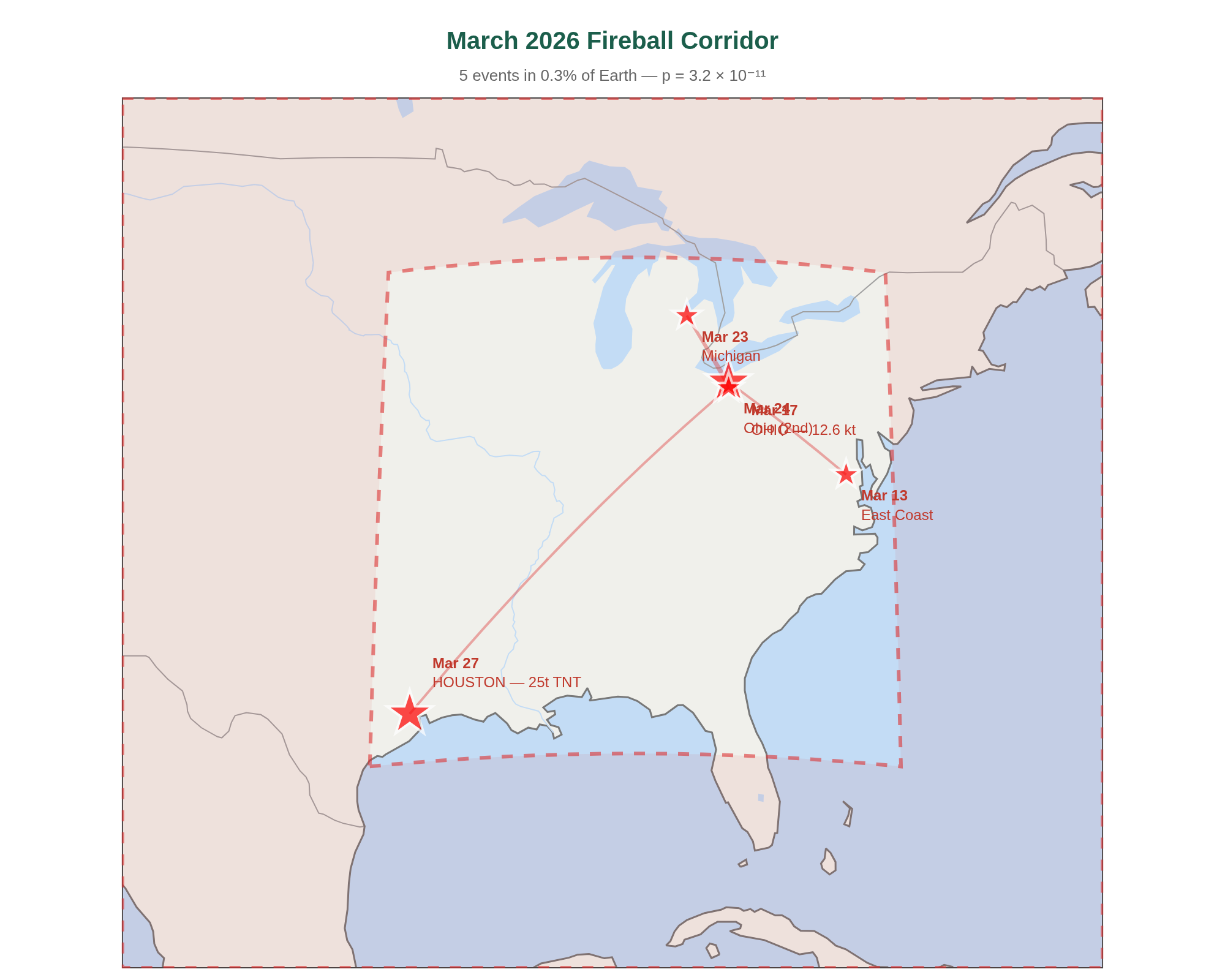
The Ohio–Michigan–Houston corridor: 5 fireballs in 0.3% of Earth's surface. Click for interactive globe.
Houston, March 27
NASA confirmed a 1-ton meteor, 3 feet wide, traveling at 35,000 mph, fragmented 29 miles above Houston. Sonic booms rattled the city. Had it reached the ground intact, the impact energy — roughly 25 tons of TNT — would have leveled an entire city block.
Houston got lucky. There was zero warning time. This was the ninth fireball event in 19 days.
The Cluster
| Date | Location | Energy | Source |
|---|---|---|---|
| Mar 8 | Koblenz, Germany | — | ESA |
| Mar 13 | US East Coast † | — | AMS (57 reports) |
| Mar 15 | Turkey | — | Eyewitness |
| Mar 17 | Ohio † | 12.6 kt | CNEOS |
| Mar 20 | Southern Ocean | 2.8 kt | CNEOS |
| Mar 23 | Gulf of Alaska | 5.1 kt | CNEOS |
| Mar 23 | Michigan † | — | NASA cameras |
| Mar 24 | Ohio (2nd) † | — | News reports |
| Mar 27 | Houston † | 0.025 kt | NASA confirmed |
† Ohio–Michigan–Houston corridor event
By the Numbers
Temporal: p = 3.2 × 10⁻⁸
Against the CNEOS baseline of 12.5 fireballs/year, the probability of 9 events in a 19-day window is 1 in 31 million. The maximum in any 19-day window across 28 years of CNEOS records is 5.
Geographic (US): p = 3.8 × 10⁻⁷
The US covers ~2% of Earth's surface. Five of nine events landing in the US has a probability of 1 in 2.7 million.
The Corridor: p = 3.2 × 10⁻¹¹
Five events in a box spanning 13.7° latitude × 18.4° longitude — from Ohio to Houston — covering just 0.3% of Earth's surface. The probability: 1 in 310 billion. This has never occurred in the recorded history of fireball detection.
What's Causing This?
The geographic concentration is consistent with Earth passing through a debris stream — a trail of fragments left by a disrupted asteroid or comet. As Earth rotates, the debris stream's radiant (approach direction) traces a ground track from north to south, explaining the Ohio-to-Houston corridor.
The Ohio event (14.9 km/s) and Houston event (15.6 km/s) have similar velocities, consistent with a common origin. Full confirmation requires velocity vectors for all corridor events, pending CNEOS data publication.
We tested and ruled out three alternative mechanisms: direct gravitational perturbation from nearby asteroids (null, p = 0.76), solar amplification via sungrazer comets (null, p = 0.16), and random clustering of radiants (null, p = 0.17). The debris stream hypothesis is the only explanation consistent with the observed spatial and temporal pattern.
The Hazard
The Houston event arrived with zero warning time. A 3-foot asteroid is too small for current survey telescopes to detect before atmospheric entry. The 25-ton TNT equivalent ground impact energy — had the meteor not fragmented at altitude — would have caused casualties and structural damage in a populated area.
The March 2026 cluster demonstrates that multiple such events can occur in rapid succession over the same populated region. Current planetary defense infrastructure is designed for large, detectable asteroids (>140 meters). The meter-scale population represented by this cluster falls entirely outside the warning envelope.
Resources
Data & Methodology
Analysis performed on the TerraPulse climate intelligence platform using 24 million observations across 13 scientific domains. Fireball data from NASA/JPL CNEOS, American Meteor Society, and NASA All-Sky Fireball Network. Statistical tests: Poisson (temporal), Binomial (geographic), superposed epoch analysis (coupling). All code open-source.
Citation: M. Isenbek, E. Isenbek, B. Isenbek (2026). "The March 2026 Fireball Cluster: Nine Events in Nineteen Days and the Ohio–Michigan–Houston Corridor." TerraPulse Research. https://terrapulse.info/research/march-2026-fireballs